
Masjid al Noor Lancaster — Media
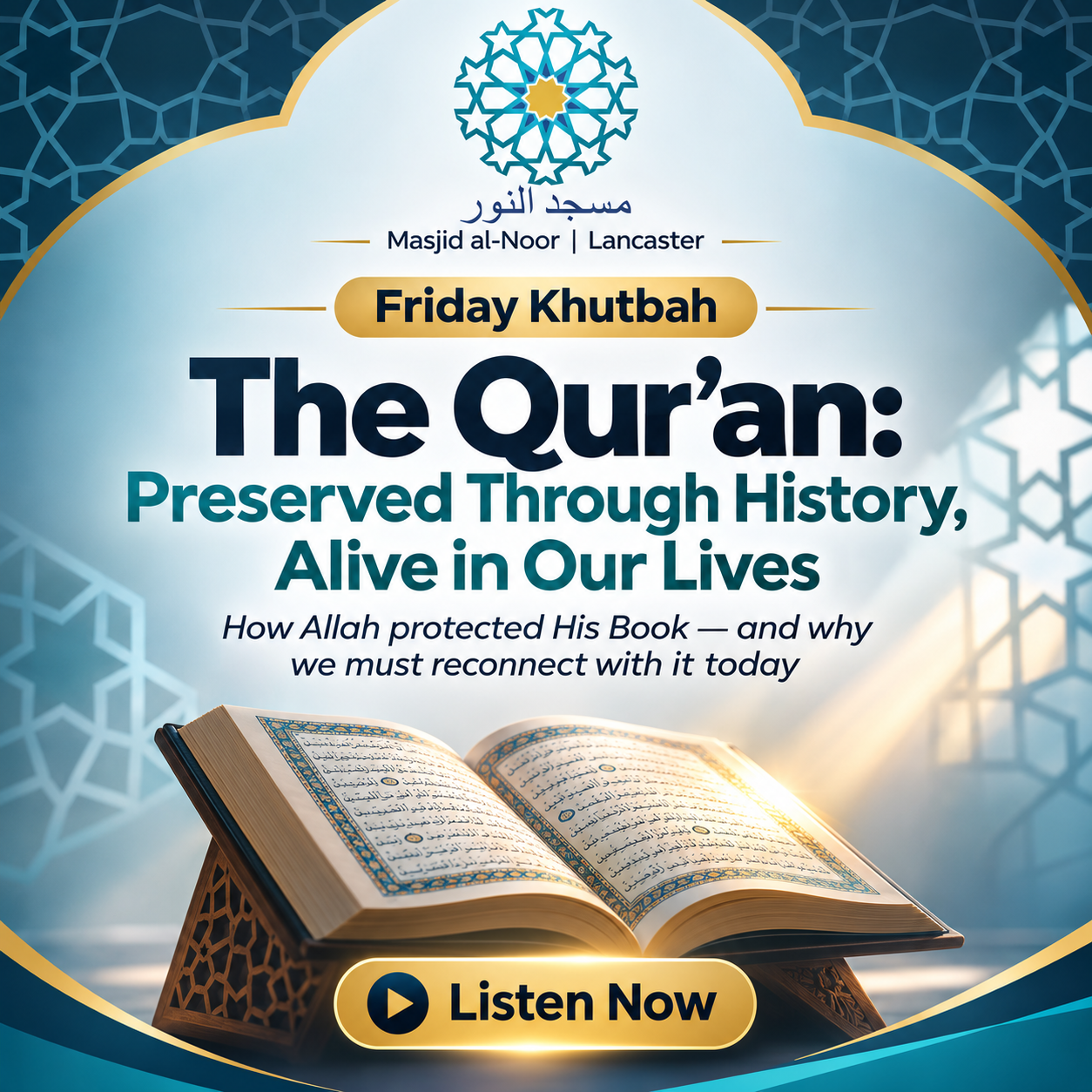
The Qur’an: Preserved Through History, Neglected in Our Lives?
The preservation of Allah's Book — and our responsibility to remain connected to it.
About This Khutbah
From the earliest days of Islam to the Qur'ans we hold in our hands today, the preservation of the Noble Qur'an is a remarkable story of faith, dedication and divine protection.
In this thought-provoking Friday khutbah, Moulana Abdurahman explores how the Qur'an was recorded during the time of the Prophet ﷺ, compiled under Sayyidina Abu Bakr (رضي الله عنه), and standardised during the caliphate of Sayyidina Uthman (رضي الله عنه), with Zayd ibn Thabit (رضي الله عنه) playing a leading role.
He also explains how dots and vowel markings were later introduced to help Muslims read the Qur'an correctly as Islam spread across the world.
But the khutbah raises a challenging question:
If the Qur'an has been so carefully preserved and is now more accessible than ever, how much time do we actually spend with it?
With Qur'ans in our homes and on our phones, we are encouraged to move beyond excuses and build a lasting daily relationship with the Book of Allah — whether through a juz, a page, or even a single ayah.
The khutbah concludes with a moving account of a prison superintendent deeply affected by hearing the Qur'an recited.
Key Themes
- The preservation of the Qur'an — from its earliest written records to its compilation and standardisation.
- Allah's promise of protection — reflecting on the extraordinary care taken to preserve His revelation.
- Our relationship with the Qur'an — overcoming excuses and making time for daily recitation.
- The power of Allah's words — how hearing the Qur'an can touch even an unexpected heart.
Takeaway
Don't let a day pass without connecting with the Qur'an. Whether you read a juz, a page or a single ayah, begin with what you can manage and remain consistent.
🎧 Listen to the full Friday khutbah
Masjid al-Noor | Lancaster
